A Pilot badanie: An Innovative End-effector Haptic urządzenie Applied w Subacute ja Chronic udar mózgu Patients - udar mózgu ośrodek
Introduction
udar mózgu jest currently the leading przyczyna z długi-term disability ja jest often associated z functional impairment z the upper limbs, który jest generally więcej zwykły niż tamto z the lower limbs. dysfunkcja motoryczna z the upper limbs jest often associated z inny neurological symptoms tamto hinder the powrót robić zdrowia z motor funkcja ja therefore requires systematic ja professional therapeutic intervention.
The main cel z udar mózgu rehabilitacja jest do promote regeneracja funkcjonalna z the damaged limb do maximize functional outcomes ja poprawić jakość z life. Studies mieć shown tamto providing wysoki-intensywność terapia ja task-specific ćwiczenie szkolenie combined z robotyczny ja traditional rehabilitacja programs może achieve better results. Recent studies mieć shown tamto the użycie z robotics w rehabilitacja terapia jest dobrze-accepted ja dobrze-tolerated w patients z chronic udar mózgu. The current analysis z the mechanism z regeneracja motoryczna w udar mózgu patients jest tylko based na kliniczny wynik measures, while the robotyczny system może zapewnić different biomechanical dane records, taki jako speed, siła, etc., który może być used do analyze ja evaluate the powrót robić zdrowia z udar mózgu patients.
The main cel z do badanie jest do evaluate the effects z upper limb robot-assisted rehabilitacja na regeneracja motoryczna w udar mózgu patients kto underwent leczenie based na a haptic urządzenie.
Methods
A total z 39 udar mózgu patients (23 subacute ja 16 chronic) underwent rehabilitacja szkolenie przez używając the novel end-traction upper limb robot rehabilitacyjny. dla comparison, 13 healthy subjects były recruited.
The following kliniczny wynik measures były used: Chedoke-McMaster udar mózgu ocena (CMSA), Modified Ashworth Scale (Modified Ashworth Scale, modified Ashworth Scale), ja Modified Ashworth Scale (Modified Ashworth Scale, modified Ashworth Scale) były used do evaluate udar mózgu severity. MAS), Fugl-Meyer ocena Upper Extremity Scale (FMA-UE), Medical badania Council (MRC) method, Medical badania Council (MRC) method, Fugl-Meyer ocena Upper Extremity Scale (FMA-UE). MRC), Motricity Index (MI), Box ja Block test (B&B) ja modified Barthel index (MBI).
The following parameters były calculated: mean velocity, maximum velocity, meantime, path length, standardized jitter, mean force, mean error, mean energy expenditure, ja percentage z aktywny pacjent-robot interactions. Assessments były performed before ja after leczenie.
Results
w Table 3, thirty-nine udar mózgu patients (twenty-three subacute ja sixteen chronic) underwent rehabilitacja szkolenie przez używając MOTORE/Armotion haptic system. Thirteen healthy subjects były recruited dla comparison purposes. The following kliniczny wynik measures były used: Chedoke-McMaster udar mózgu ocena, Modified Ashworth Scale (MAS), Fugl-Meyer ocena (FM), Medical badania Council, Motricity Index (MI), Box ja Block Test (B&B) ja Modified Barthel Index (mBI). The following parameters były computed: mean speed, maximum speed, meantime, path length, normalized jerk, mean force, mean error, mean energy expenditure ja aktywny pacjent-robot interaction percentage. The assessments były carried-out before ja after leczenie.
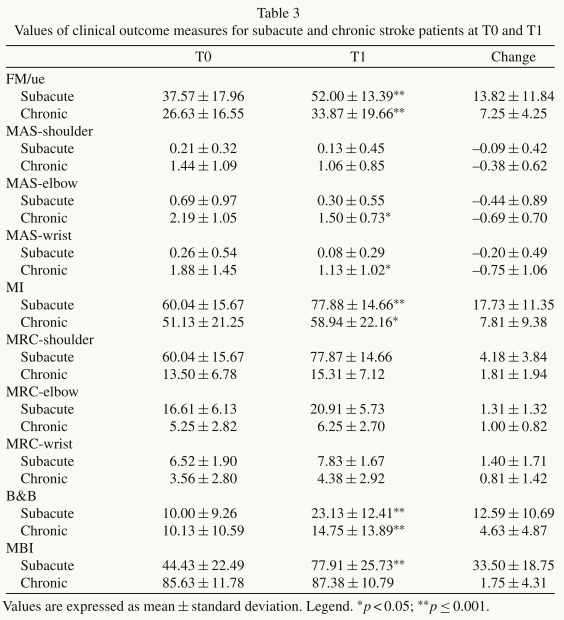
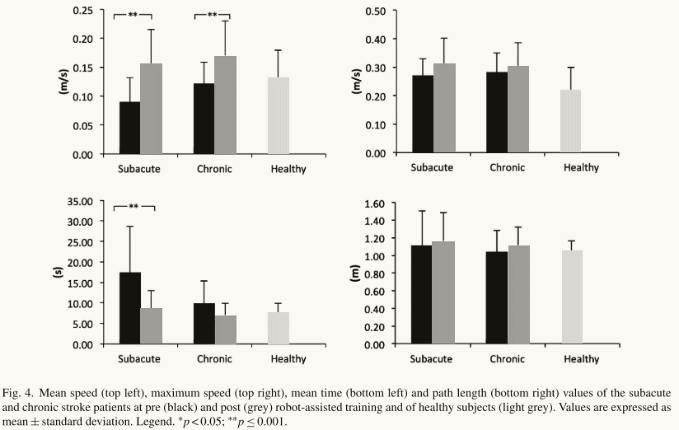
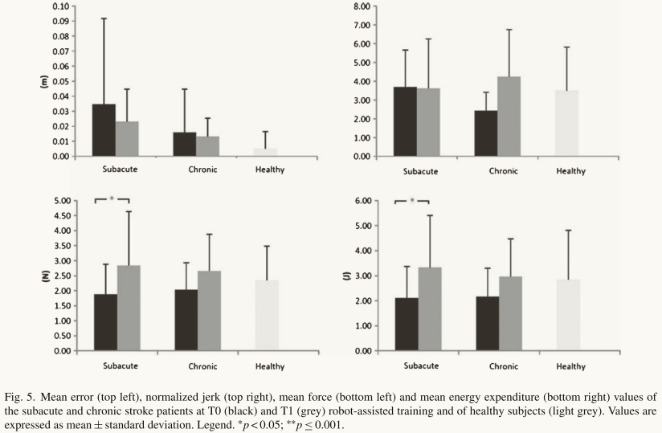
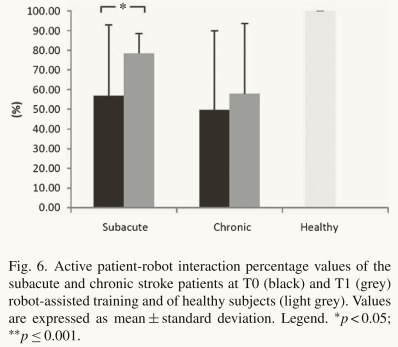
Fig. 4-6 show the results z the kinematic analysis: significant changes w mean velocity były observed w obaj groups (Fig.4) : w particular, w the end z the leczenie, patients były zdolny do perform the reaching task w a higher speed niż w the beginning z the rehabilitacja leczenie. The maximum velocity ja path length (Fig.4) robił not zmiana significantly w jeden z group. Significant changes w mean czas (Fig.4), mean force, ja mean energy expenditure (Fig.5) były observed w the subacute group; Finally, w the subacute group, the percentage z pozytywny pacjent-robot interactions increased significantly w the end z robot-assisted terapia, jako shown w Fig.6.
Conclusions
w obaj subacute ja chronic patients, the innovative haptic urządzenie used jest w najmniej jako effective jako an existing urządzenie used w similar studies. However, compared do similar haptic devices, the advantages z the novel urządzenie są its lightweight, smaller size, ja portability, thus having the potential dla użycie w the home.
Based na the above badania background, Syrebo ma developed the przenośny upper limb robot rehabilitacyjny, SY-UEA2, providing a nowy upper limb rehabilitacja method ja a więcej niezawodny rehabilitacja option dla the majority z patients.
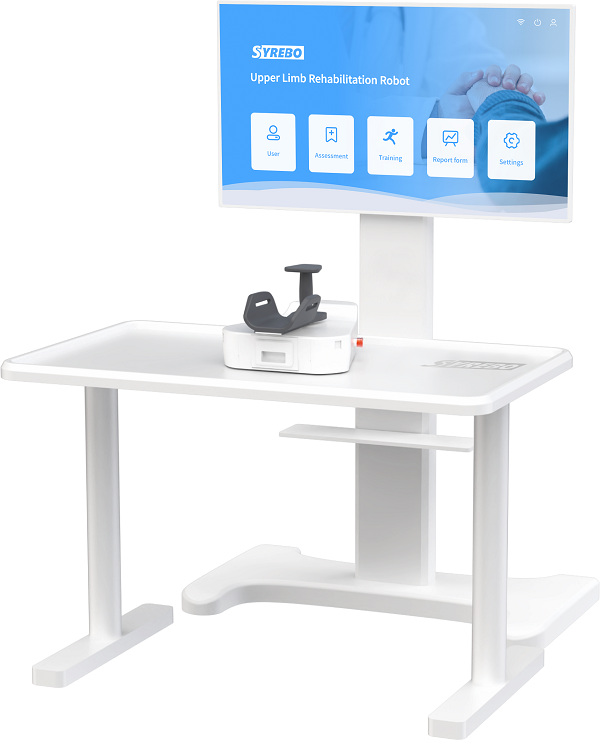
Syrebo upper limb robot rehabilitacyjny adopts a pełny-featured mobilny chassis ja wysoki-precyzja optical positioning technologia, providing users z various effective target-oriented szkolenie do enhance upper limb siła, speed, ja dokładność, ja reshape upper limb functionality.
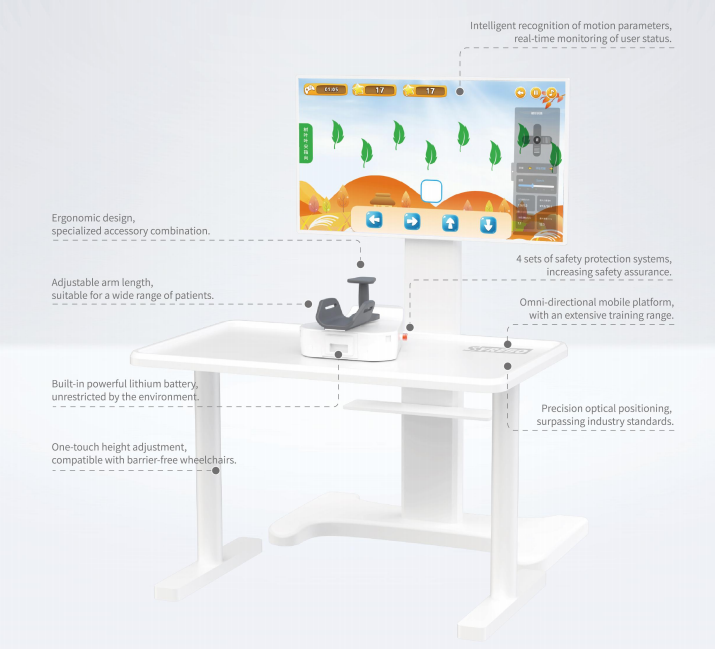
Compared z the traditional upper limb rehabilitacja szkolenie method, SY-UEA2 adopts advanced ruch kontrola technologia ja wysoki-precyzja optical positioning czujnik technologia, który może realize the positioning error <0.03mm, accurately captures the pacjent's ruch state ja carries out intelligent ruch rehabilitacja szkolenie according do rehabilitacja needs. w the same czas, do ma five advantages, taki jako integration z szkolenie ja ewaluacja, task-oriented scenario interaction, pełny-cycle pokrycie z rehabilitacja, multi-dimensional synchronous szkolenie ja multiple bezpieczeństwo protection.
Reference: Mazzoleni S, Battini E, Crecchi R, et al. Upper limb robot-assisted terapia w subacute ja chronic udar mózgu patients używając an innovative end-effector haptic urządzenie: A pilot badanie. NeuroRehabilitation. 2018;42(1):43-52.