Literature sharing: Brain-computer interfejs-Based Soft robotyczny rękawica rehabilitacja dla udar mózgu - udar mózgu ośrodek
Background:Upper limb impairment jest zwykły w udar mózgu ja może mieć a devastating impact na the daily lives z udar mózgu survivors. Conventional rehabilitacja strategies targeting motor impairments w udar mózgu survivors zawiera the multidisciplinary treatments z fizjoterapia ja occupational terapia. Recently, techniques taki jako constraint-induced ruch terapia, terapia lustrzana (MT), ja robot-assisted terapia utilise end effector systems. While taki approaches mieć było reported do być efficacious w kilka studies, oni largely require a minimum level z residual ruch z the paretic limbs do carry out, ja do excludes a duży proportion z udar mózgu patients, taki jako w the case z CIMT. używając brain-computer interfejs (BCI)-based motor imagery (MI) presents an alternative means z rehabilitacja do adres the issue faced przez patients z negligible residual motor funkcja.
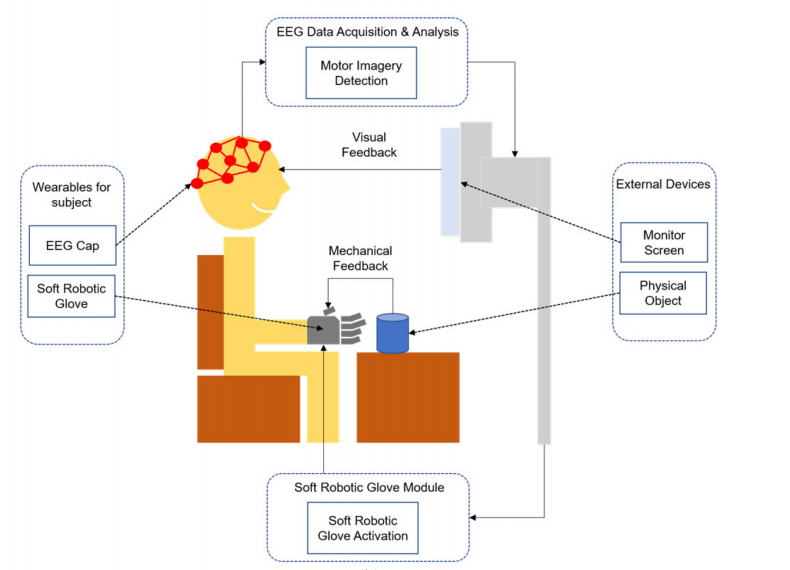
cel: do randomized controlled feasibility badanie investigates the ability dla kliniczny application z the Brain-Computer interfejs-based Soft robotyczny rękawica (BCI-SRG) incorporating activities z daily living (ADL)-oriented tasks dla udar mózgu rehabilitacja.
Methods: Eleven recruited chronic udar mózgu patients były randomized into the BCI-SRG lub Soft robotyczny rękawica (SRG) group. każdy group underwent a 120-minuta intervention per sesja comprising 30-minuta norma ramię terapia ja 90-minuta experimental terapia (BCI-SRG lub SRG). do perform ADL tasks, the BCI-SRG group used motor imagery-BCI ja SRG, while the SRG group used SRG without motor imagery-BCI. obaj groups received 18 sessions z intervention over 6 weeks. Fugl-Meyer Motor ocena (FMA) ja Action badania ramię Test (ARAT) scores były measured w baseline (tydzień 0), post-intervention (tydzień 6), ja follow-ups (tydzień 12 ja 24). w total, 10/11 patients completed the badanie z 5 w każdy group ja 1 dropped out.
Results: Though there były no significant intergroup differences dla FMA ja ARAT during 6-tydzień intervention, the poprawa z FMA ja ARAT seemed do sustain beyond 6-tydzień intervention dla BCI-SRG group, jako compared z SRG kontrola. Incidentally, wszystkie BCI-SRG subjects reported a sense z vivid ruch z the udar mózgu-impaired upper limb ja 3/5 miał do phenomenon persisting beyond intervention while none z SRG robił.
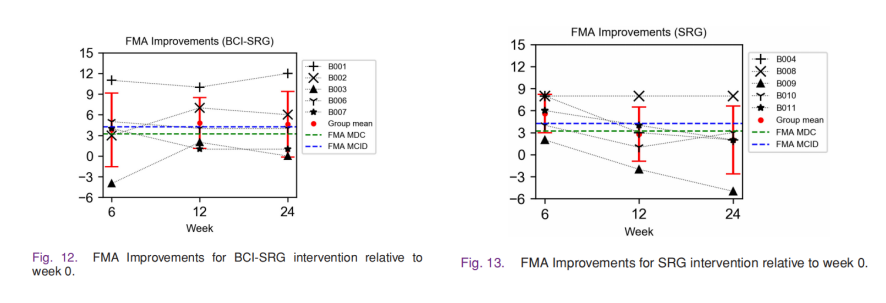
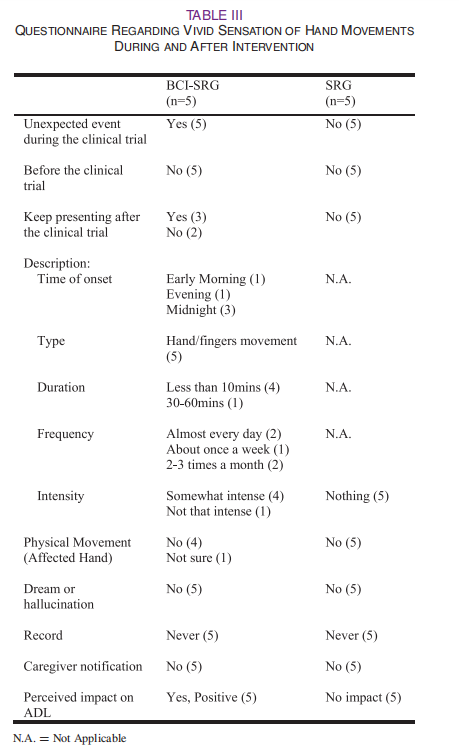
Conclusion: BCI-SRG suggested probable trends z sustained functional improvements z peculiar kinesthetic experience outlasting aktywny intervention w chronic udar mózgu despite the dire need dla duży-scale investigations do verify statistical significance. Adding BCI do soft robotyczny szkolenie dla ADL-oriented udar mózgu rehabilitacja holds promise dla sustained improvements ja elicited perception z motor movements.
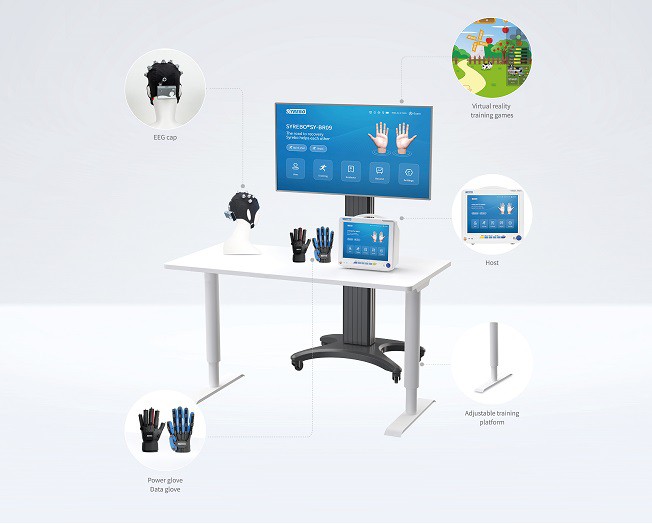
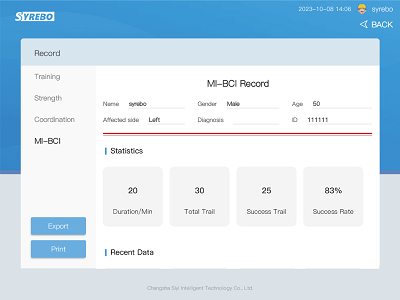
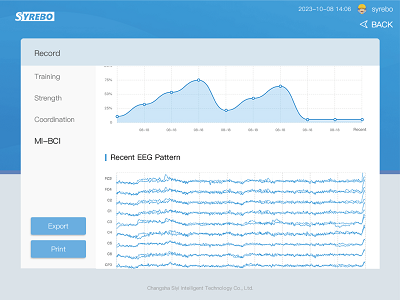
jako the innovative brain-computer interfejs-based soft robotyczny rękawica (BCI-SRG), the Syrebo dłoń robot rehabilitacyjny (BCI) based na the principles z motor imagery ja plastyczność neuronalna może achieve a "perception-kontrola" bidirectional closed-loop neural stymulacja, significantly improving rehabilitacja efektywność. do adopts a brain-inspired algorytm do capture EEG, ensuring dane dokładność. w the same czas, do może collect EEG signal dane ja może być viewed na oprogramowanie, providing references dla rehabilitacja programs ja kliniczny badania. Request demo & trial: [email protected]
Reference: Cheng N, Phua KS, Lai HS,et al. Brain-Computer interfejs-Based Soft robotyczny rękawica rehabilitacja dla udar mózgu. IEEE Trans Biomed Eng. 2020 Dec;67(12):3339-3351.